Contracts the quantity you type into the order box · Face value how many coins (USDT-margined) or how many US dollars (coin-margined) one contract stands for · Price the fill price, or an assumed price you're estimating with
USDT-margined BTCUSDT
One contract: 0.01 BTC. At an assumed 80,000 USDT, 1 × 0.01 × 80,000 = 800 USDT.
Coin-margined BTCUSD
One contract: $100. To get the coin amount, divide by price: at an assumed 80,000, 100 ÷ 80,000 = 0.00125 BTC.
Working back to contracts
USDT-margined: contracts = coins you want ÷ face value. 0.05 BTC ÷ 0.01 = 5 contracts, and the result also has to be a whole multiple of the lot size.
On OKX perpetuals, “one contract” has no single fixed amount. The face value and the smallest quantity you can order are set contract by contract: USDT-margined perpetuals (USDT as collateral) state face value in coins, and coin-margined perpetuals state it in US dollars. The table below shows readings from OKX's official API as of September 2026.
Face value of one contract on OKX's main perpetuals
| Contract | Margin type | Face value per contract | Minimum order / lot size | Smallest order equals |
|---|---|---|---|---|
| BTCUSDT perp | USDT-margined | 0.01 BTC | 0.01 / 0.01 contracts | 0.0001 BTC |
| ETHUSDT perp | USDT-margined | 0.1 ETH | 0.01 / 0.01 contracts | 0.001 ETH |
| SOLUSDT perp | USDT-margined | 1 SOL | 0.01 / 0.01 contracts | 0.01 SOL |
| XRPUSDT perp | USDT-margined | 100 XRP | 0.01 / 0.01 contracts | 1 XRP |
| DOGEUSDT perp | USDT-margined | 1,000 DOGE | 0.01 / 0.01 contracts | 10 DOGE |
| BTCUSD perp | Coin-margined | $100 | 0.1 / 0.1 contracts | $10 |
| ETHUSD perp | Coin-margined | $10 | 1 / 1 contract | $10 |
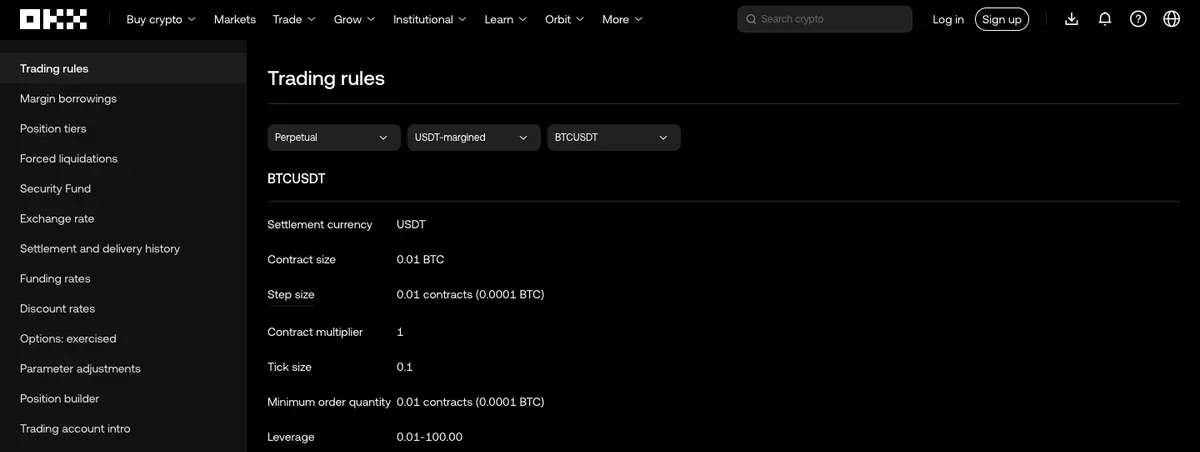
Face value, minimum order size and lot size come from the ctVal, minSz and lotSz fields of OKX's public endpoint /api/v5/public/instruments; the BTCUSDT row matches OKX's trading rules page. Last column = minimum order size × face value.
In the five USDT-margined rows, face value is counted in the coin itself. One DOGEUSDT contract is 1,000 DOGE, while one BTCUSDT contract is only 0.01 BTC, so the same number of contracts can mean very different amounts of coin and money. Before you carry a contract count that feels natural on BTC over to another coin, redo the conversion with that coin's face value.
The two coin-margined rows work the other way round: face value is in US dollars. One BTCUSD contract is $100 and one ETHUSD contract is $10. The smallest order on both comes to $10, but BTCUSD moves in steps of 0.1 contracts while ETHUSD only moves in whole contracts.
Coins not in the table also have their own face value and minimum order; how to look them up is in the last section.
“One BTC contract is $100” refers to coin-margined BTCUSD
The $100 figure is the face value of the coin-margined BTCUSD contract, and the one-contract minimum on BTCUSDT is a rule from before OKX's April 2024 announcement that cut the minimum order size. When OKX's help center explains how the two contract types differ, it says a USDT-margined perpetual contract is valued in the underlying coin, with BTCUSDT at a face value of 0.01 BTC, while a coin-margined perpetual contract is valued in USD, with BTCUSD at a face value of 100 dollars.
The two types differ in more than the unit of face value:
- Coin-margined (also called inverse contracts): quoted in USD, with margin and PnL both in the underlying coin. To open BTCUSD you first transfer in BTC, and you win or lose in BTC too.
- USDT-margined (also called linear contracts): quoted in USDT, and every coin uses USDT for margin and PnL, so holding USDT is enough to trade contracts on any coin.
What one BTCUSDT contract is worth in dollars depends on the BTC price at the time: 0.01 × price. The help center's example uses BTC at $10,000, when 0.01 BTC also happens to be $100, so opening 1 BTC takes 100 contracts on either type. Once price moves they no longer line up: at an assumed 80,000 USDT, one USDT-margined contract is 800 USDT, while one coin-margined contract is still $100.
Converting OKX contracts into coins and USDT
USDT-margined perpetuals use these three formulas:
- Coins = contracts × face value
- Notional (USDT) = contracts × face value × price
- Contracts = coins ÷ face value = notional ÷ (face value × price)
On coin-margined perpetuals the face value is in dollars, so the formulas become: dollar value = contracts × face value; coin equivalent = contracts × face value ÷ price.
Every price below is an assumption, BTC at 80,000 USDT and ETH at 3,000 USDT, and doesn't reflect the market at any point in time.
Example 1, opening 5 contracts of BTCUSDT. Coins: 5 × 0.01 = 0.05 BTC; notional: 0.05 × 80,000 = 4,000 USDT. At 10x leverage the initial margin is 4,000 ÷ 10 = 400 USDT, before fees. The help center's example follows the same relationship: with BTC at $10,000, 1,000 USDT at 10x opens a 1 BTC long.
Close those 5 long contracts at 82,000 and the PnL follows OKX's contract specification page, which gives the PnL on closing a long as quantity (in coins) × average close price − quantity (in coins) × average open price: 0.05 × 82,000 − 0.05 × 80,000 = 100 USDT, with fees and funding counted separately.
Example 2, a 1,000 USDT position in ETHUSDT. Contracts = 1,000 ÷ (0.1 × 3,000) = 3.333… With a lot size of 0.01 contracts, you can only order 3.33 contracts (notional 3.33 × 0.1 × 3,000 = 999 USDT) or 3.34 contracts (1,002 USDT); no size lands exactly on 1,000.
Example 3, 20 contracts of coin-margined BTCUSD. Dollar value: 20 × 100 = $2,000; coin equivalent: 2,000 ÷ 80,000 = 0.025 BTC. That 0.025 BTC moves with the price, while the contract count and the dollar value stay the same.
Once you have the margin and leverage, you can enter 400 USDT, 10x and an entry price of 80,000 into the perp position calculator to see a liquidation estimate for the position. At the same face value, 30 BTC contracts opened from a 300 USDT account come to 0.3 BTC, a sizing slip that sits among the perpetual futures rookie mistakes.
The smallest order you can place on an OKX perpetual
Minimum order size and lot size are two separate values. Lot size is the smallest step by which a quantity can go up or down; minimum order size is the fewest contracts a single order can start from. OKX's April 2024 announcement states that the quantity of a new or amended order must be a whole multiple of the lot size and no smaller than the minimum order size. For BTCUSDT both values are now 0.01 contracts, so 0.01, 0.02 or 1.25 contracts all work, but 0.005 or 1.255 contracts don't.
A one-contract minimum used to be the rule on BTCUSDT. On April 19, 2024, OKX announced that the minimum order size and lot size for BTC/USDT perpetual and expiry futures would drop from 1 contract (0.01 BTC) to 0.1 contracts (0.001 BTC), taking effect on April 25, 2024, 14:00–16:00 (UTC+8). The specification page and the API now show 0.01 contracts (0.0001 BTC), which means it has been lowered again since.
These changes are made one contract at a time. An announcement on November 14, 2025 cut the minimum order size of two perpetuals, H/USDT and SOON/USDT, from 1 contract to 0.1 contracts, effective November 21; by the conversion given in that announcement, one H/USDT contract before the change was 100 H. A minimum contract count taken from an older tutorial may not hold today.
Once the step size is below one contract, positions and orders show their contract counts as decimals, including unfilled, partially filled and filled orders. A BTCUSDT position showing 0.35 contracts is 0.0035 BTC.
There's a ceiling too. The BTCUSDT perpetual specification page lists a single market order at 0.01 to 35,000 contracts, or 0.0001 to 350 BTC; a market order above that has to be split into several.
How can you check a contract's current face value and minimum order?
On the web, open OKX's Trading rules page (okx.com/trade-market/info/swap). Use the three dropdowns at the top to pick the contract type, the margin type and the trading pair, and the right-hand side lists the settlement currency, face value, lot size, minimum order size, leverage and order rules. With perpetual, USDT-margined and your pair selected, the Contract size line tells you how many coins one contract is, and the Minimum order quantity line tells you the fewest contracts you can order.
Before ordering in the app, check which kind of contract you're on: in the trading section, open contracts and tap the contract pair on the page to switch between USDT-margined and coin-margined. If you're holding USDT but sitting on a coin-margined page, each contract you order follows the dollar-based face value.
If you place orders through code, call the public endpoint GET /api/v5/public/instruments?instType=SWAP&instId=BTC-USDT-SWAP, swapping instId for the contract you want. In the response, ctVal is the face value, ctValCcy is its unit (a coin code for USDT-margined, USD for coin-margined), minSz is the minimum order size and lotSz is the lot size. The April 2024 announcement also states that when OKX changes lot size and minimum order size, the lotSz and minSz returned by the API update to the new values, so don't hard-code those two numbers.
If any of the terms are unfamiliar, the USDT-margined (linear) entry in the OKX perpetual futures glossary uses the same face value of 1 contract = 0.01 BTC.